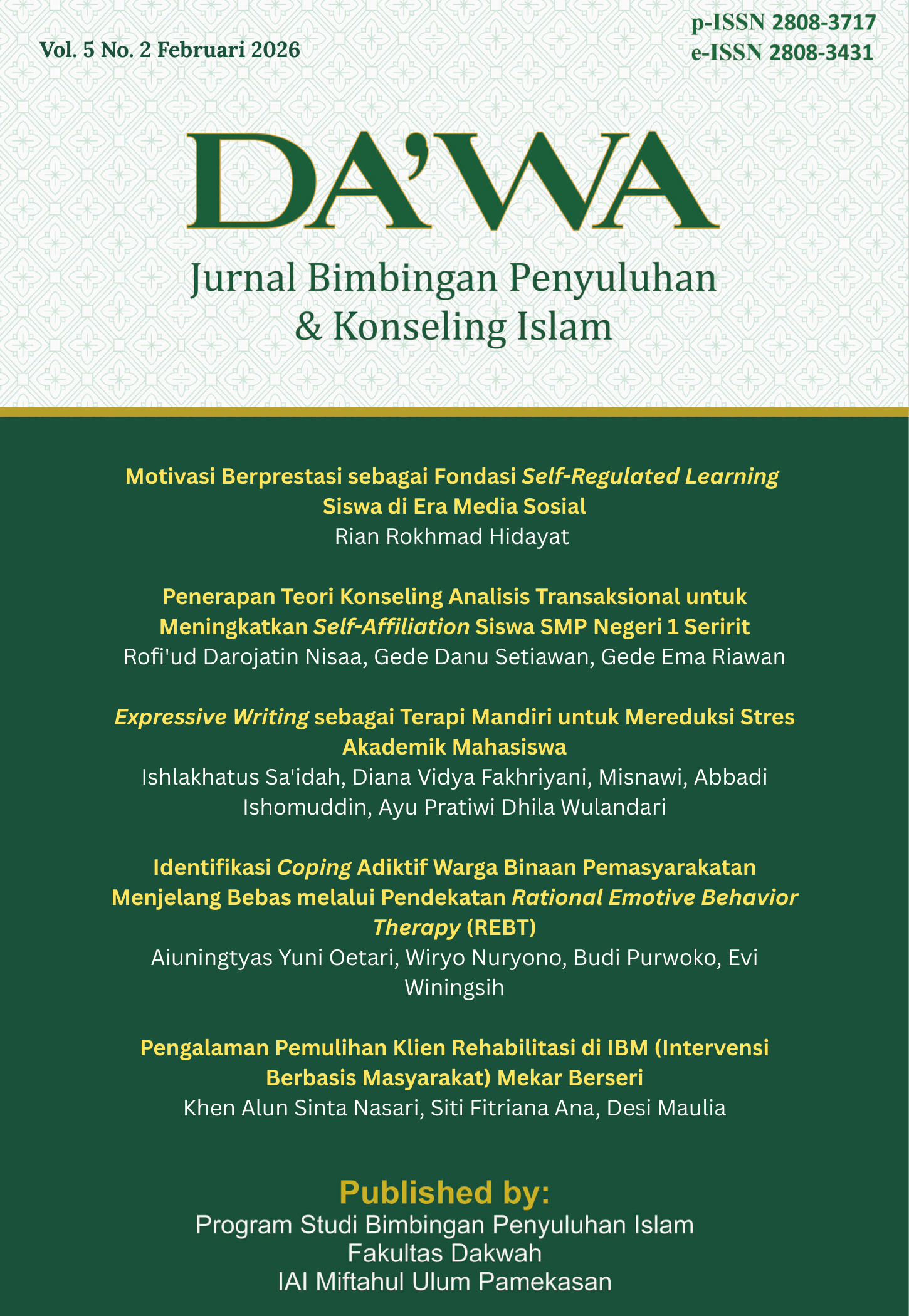
Motivasi Berprestasi sebagai Fondasi Self-Regulated Learning Siswa di Era Media Sosial
DOI:
https://doi.org/10.36420/eh0s0676Keywords:
Motivasi Berprestasi, Kebiasaan Belajar Siswa, Self-Regulated LearningAbstract
Hasil penelitian terdahulu mengenai kontribusi motivasi berprestasi terhadap self-regulated learning (SRL) menunjukkan hasil yang signifikan, namun belum ada penelitian yang menguji pengaruhnya pada kondisi saat ini di mana media sosial memiliki pengaruh terhadap keseluruhan kehidupan siswa termasuk pada mereka belajar secara mandiri di rumah. Penelitian ini bertujuan untuk mengetahui apakah motivasi berprestasi para siswa mempengaruhi SRLnya, terutama saat mereka melakukan kegiatan belajar di rumah. Penelitian ini menggunakan metode korelasional yang berusaha untuk memprediksi apakah SRL seorang siswa dapat ditinjau dari motivasi berprestasinya. Penelitian ini menggunakan analisis regresi sederhana satu jalur untuk melihat pengaruh motivasi berprestasi terhadap SRL para siswanya. Sampel penelitian ini adalah para siswa SMA dari enam provinsi di pulau jawa dengan teknik convenience sampling. Hasil penelitian menunjukkan bahwa motivasi berpresasi mempengaruhi SRL para siswa. Analisis regresi satu jalur menunjukkan skor p-value 0,00 (0,00 <0,05) dengan koefisien regresi 0.445 yang menunjukkan adanya pengaruh dari motivasi berprestasi terhadap SRL siswa. Koefisien korelasi antara motivasi berprestasi dengan SRL yaitu sebesar 0,667 yang menunjukkan adanya hubungan kuat yang positif antar dua variabel yang diteliti sehingga dapat disimpulkan bahwa teori klasik mengenai pengaruh motivasi berprestasi terhadap SRL masih relevan di era distrupsi media sosial saat ini.
References
Abdullah, Sri Muliati. 2019. “Social Cognitive Theory : A Bandura Thought Review Published in 1982-2012.” Psikodimensia 18 (1): 85. https://doi.org/10.24167/psidim.v18i1.1708.
Abun, Damianus. 2021. “Academic Self-Regulation of STEM of Senior High School Students of Divine Word Colleges in Region I, Philippines and Their Academic Performance.” SSRN Electronic Journal. https://doi.org/10.2139/ssrn.3807851.
Andrade, C. 2021. “The Inconvenient Truth About Convenience and Purposive Samples.” Indian Journal of Psychological Medicine 43 (1): 86–88. https://doi.org/10.1177/0253717620977000.
Balkin, Richard S., and David M. Kleist. 2025. “Examining Relationships.” In Counseling Research: A Practitioner-Scholar Approach, Second Edition, 125–40. https://doi.org/10.1002/9781394346899.ch6.
Billman, A. 2024. “Impact Analysis of the Use of Artificial Intelligence with Self-Regulated Learning Theory on Student Academic Performance in Indonesia.” In Proceedings of the International Conference on Computer Engineering, Network and Intelligent Multimedia, CENIM 2024. https://doi.org/10.1109/CENIM64038.2024.10882800.
Broadbent, J, and P de Barba. 2023. “Self-Regulated Learning and the Student Experience in Online Higher Education.” In Research Handbook on the Student Experience in Higher Education, 179–90. https://doi.org/10.4337/9781802204193.00021.
Broadbent, J, and W L Poon. 2015. “Self-Regulated Learning Strategies & Academic Achievement in Online Higher Education Learning Environments: A Systematic Review.” The Internet and Higher Education 27: 1–13. https://doi.org/https://doi.org/10.1016/j.iheduc.2015.04.007.
Chang, Daniel H, Michael Pin-Chuan Lin, Shiva Hajian, and Quincy Q Wang. 2023. “Educational Design Principles of Using AI Chatbot That Supports Self-Regulated Learning in Education: Goal Setting, Feedback, and Personalization.” Sustainability 15 (17): 12921. https://doi.org/10.3390/su151712921.
Chiu, Thomas K F. 2021. “Digital Support for Student Motivation and Self-Regulated Learning in Blended Learning Environments.” Computers in Human Behavior 124: 106909. https://doi.org/10.1016/j.chb.2021.106909.
Dede, Hülya. 2024. “An Investigation into Factors of Turkish Secondary School Students’ Learning Engagement in Science Courses.” DergiPark (Istanbul University). https://dergipark.org.tr/tr/pub/ofed/issue/85094/1420124.
Di, Xuan, and Bingxin Gu. 2024. “The Mediating Role of Self-Regulated Learning Strategies on Learners’ Social Media Usage and Motivation.” In IntechOpen EBooks. IntechOpen. https://doi.org/10.5772/intechopen.1006135.
ElAdl, Adel M, and Hussain Alkharusi. 2020. “Relationships between Self-Regulated Learning Strategies, Learning Motivation and Mathematics Achievement.” Cypriot Journal of Educational Sciences 15 (1): 104–11. https://doi.org/10.18844/cjes.v15i1.4461.
Eom, S. 2015. “The Effects of Student Motivation and Self-Regulated Learning Strategies on Students’ Perceived e-Learning Outcomes and Satisfaction.” In AIS SIGED: IAIM International Conference. https://www.scopus.com/inward/record.uri?eid=2-s2.0-84976293874&partnerID=40&md5=0dacced71e370ebc2ef0ebd67ddd670c.
Hidayat, Rian Rokhmad, Fattah Hanurawan, M. Ramli, Arbin Janu Setyowati, and Moh Salimi. 2023. “Why Do Indonesian Teens Have Tempted To Do Sexting? Implications For School Counselors Why Teenagers Temped to Do Sexting.” In Proceedings of the 6th International Conference on Learning Innovation and Quality Education, 5:188–99. Atlantis Press SARL. https://doi.org/10.2991/978-2-38476-114-2_18.
Hindradjat, Juliana, Imam Hambali, Adi Atmoko, and P H Livana. 2022. “The Effect of Achievement Motivation and Self-Regulated Learning on Student Learning Behavior in the Time of Online Learning in Indonesia.” Open Access Macedonian Journal of Medical Sciences 10: 262–72. https://doi.org/10.3889/oamjms.2022.8279.
Iyiola, Ebunoluwa T, Judith Chineye Azikiwe, and Benjamin O Omolayo. 2021. “Undergraduates Self-Regulated Learning: The Place of Social Media Addiction and Learning Strategies.” Indonesian Journal of Curriculum and Educational Technology Studies 9 (1): 25–33. https://doi.org/10.15294/ijcets.v9i1.43726.
Kranjec, Eva, and Karin Bakračevič. 2023. “Differences in Self-Regulated Learning Between Gifted Students, Students with Special Needs and Other Students in Slovenian Schools.” International Journal of Instruction 16 (3): 505–18. https://doi.org/10.29333/iji.2023.16327a.
Mikarnad, R, E P Sari, and A Nugroho. 2021. “Self-Regulation in Social Media Use and Its Relationship with Students’ Learning Motivation.” Journal of Educational Psychology 9 (2): 112–23.
Moghadari-Koosha, M, M Moghadasi-Amiri, F Cheraghi, H Mozafari, B Imani, and M Zandieh. 2020. “Self-Efficacy, Self-Regulated Learning, and Motivation as Factors Influencing Academic Achievement among Paramedical Students a Correlation Study.” Journal of Allied Health 49 (3): 145E-152E. https://www.scopus.com/inward/record.uri?eid=2-s2.0-85090261445&partnerID=40&md5=de1af7377702da3ae1fe85b02fb4777a.
Myrick, J G, and Y Yang. 2022. “Social Cognitive Theory.” In The International Encyclopedia of Health Communication, 1–4. https://doi.org/10.1002/9781119678816.iehc0666.
Purwadi, P, and W N E Saputra. 2023. “Creative Reality Counseling Model: Acceptability and Effectiveness at Improving Self-Regulated Learning.” International Journal of Evaluation and Research in Education 12 (3): 1290–98. https://doi.org/10.11591/ijere.v12i3.24755.
Ramadhani, R, E Syahputra, and E Simamora. 2024. “The Construct Validity of Self-Regulated Learning Questionnaire for Senior High School Students: A Rasch Model Analysis.” International Journal of Evaluation and Research in Education 13 (3): 2032–38. https://doi.org/10.11591/ijere.v13i3.26816.
Shell, D F, M P Hazley, L.-K. Soh, E Ingraham, and S Ramsay. 2013. “Associations of Students" Creativity, Motivation, and Self-Regulation with Learning and Achievement in College Computer Science Courses.” In Proceedings - Frontiers in Education Conference, FIE, 1637–43. https://doi.org/10.1109/FIE.2013.6685116.
Vicente, Marta Martínez, José Manuel Suárez Riveiro, and Carlos Valiente Barroso. 2023. “Strategic-Motivational Profile and Academic Achievement in Primary School Students.” Educación XX1 26 (1): 141–63. https://doi.org/10.5944/educxx1.31852.
Vo, L T H, X T Nguyen, and L T T Vo. 2024. “Factors Affecting the Motivation of Learners Studying English for Specific Purposes.” In Addressing Issues of Learner Diversity in English Language Education, 61–77. https://doi.org/10.4018/979-8-3693-2623-7.ch004.
Wolters, Christopher A, and Paul R Pintrich. 2001. “Contextual Differences in Student Motivation and Self-Regulated Learning in Mathematics, English and Social Studies Classrooms.” In Neuropsychology and Cognition, 103–24. Springer Nature (Netherlands). https://doi.org/10.1007/978-94-017-2243-8_6.
Wong, J, M Khalil, V Suschevskiy, M Baars, B de Koning, and F Paas. 2026. “Student Engagement Profiles in a Mobile App: Links to Self-Regulated Learning and Performance.” Educational Technology Research and Development. https://doi.org/10.1007/s11423-026-10586-2.
Xu, Xiaoqing, Lifang Qiao, Nuo Cheng, Hongxia Liu, and Wei Zhao. 2025. “Enhancing Self‐regulated Learning and Learning Experience in Generative AI Environments: The Critical Role of Metacognitive Support.” British Journal of Educational Technology 56 (5): 1842–63. https://doi.org/10.1111/bjet.13599.
Zimmerman, B J. 2002. “Becoming a Self-Regulated Learner: An Overview.” Theory Into Practice 41 (2): 64–70.
Downloads
Published
Issue
Section
License
Copyright (c) 2026 Rian Rokhmad Hidayat (Author)

This work is licensed under a Creative Commons Attribution 4.0 International License.