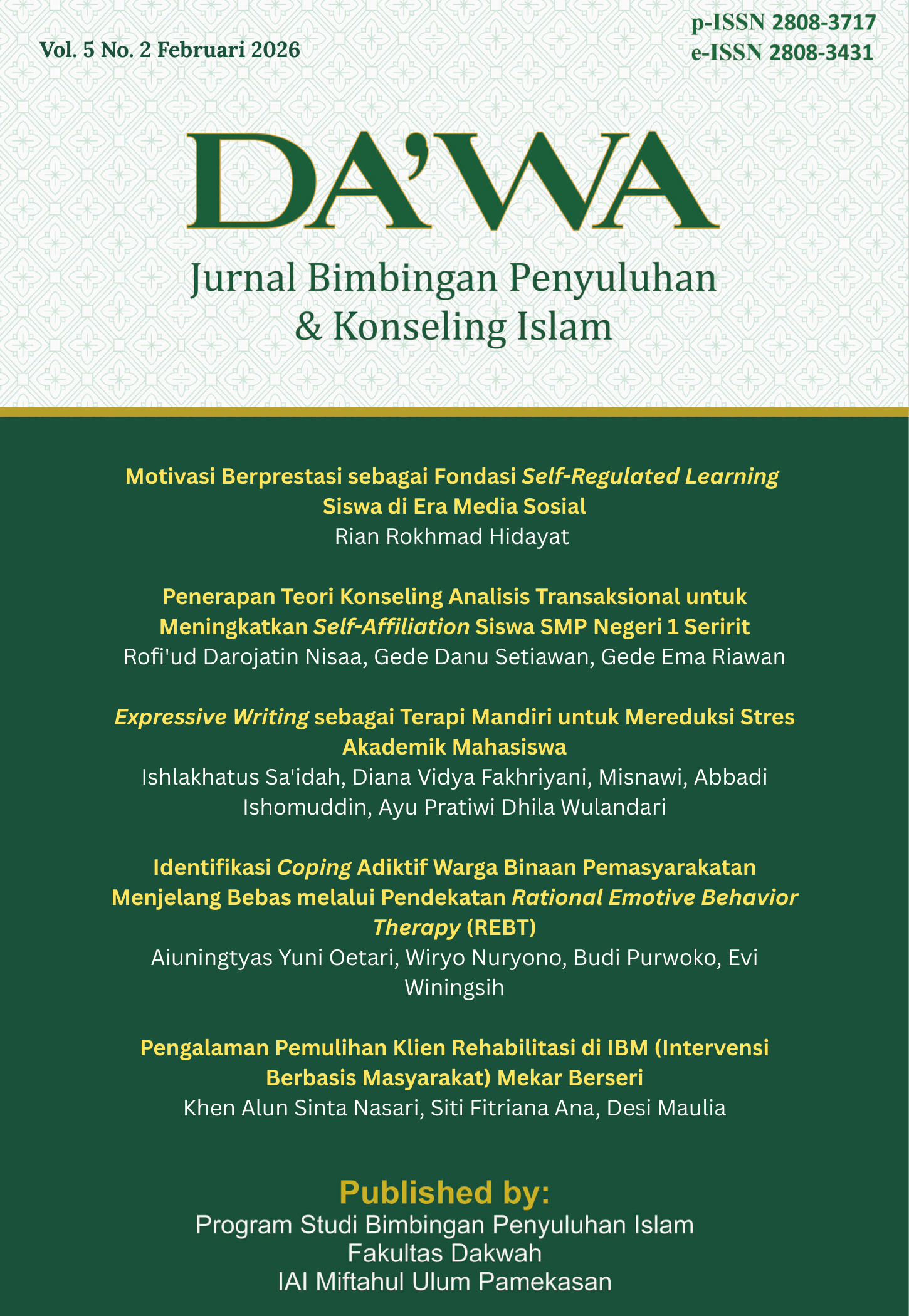
Identifikasi Coping Adiktif Warga Binaan Pemasyarakatan Menjelang Bebas melalui Pendekatan Rational Emotive Behavior Therapy (REBT)
DOI:
https://doi.org/10.36420/xckpyj16Keywords:
narkotika, coping adiktif, kognitif perilaku, rasional emotive behavior therapy, adiksi, bimbingan dan konseling, penyalahgunaan narkotika, residivisme, relapsAbstract
Drug abuse is one of the focus of problems that is still urgent until now, the real impact of users is seen and felt not only biologically but also psychologically. The tendency to relapse or relapse in drug users is an obstacle in prevention and rehabilitation efforts for drug users. This study aims to help clients/counselees in finding new rational beliefs and identifying addictive coping patterns that can trigger relapse, repeating crimes, or recidivism in former drug users. The method used in this study is Qualitative with a Case Study model on the subjects of five Correctional Residents (WBP) aged 20-25 years in the final period of detention who are former drug users. Data collection techniques are carried out through observation, counseling interviews, and documentation. The approach used in therapy is Cognitive Behavioral Counseling with the Rational Emotive Behavior Therapy (REBT) approach. The main results of this study indicate the existence of irrational beliefs that trigger relapse tendencies such as; (1) Responsibility or burden of life after release, (2) Statements about easy access to narcotics, (3) Fear of negative judgment from society or those closest to them. The interconnectedness of these three factors forms an addictive coping pattern that emerges as a means of self-preservation to avoid anxiety before release. This study highlights addictive coping as a cognitive response to anxiety before release, which has not been widely studied in the context of the reintegration of narcotics inmates. The practical implications of this study include: (1) for counselors, understanding the client's cognitive and emotional state is crucial in eliminating irrational thought patterns and addictive coping as potential recidivism; (2) for school counselors, the finding that early exposure to narcotics during school confirms the need for early preventive intervention through the development of emotional regulation, rational thinking patterns, and skills in dealing with peers; (3) for the Development of the Guidance and Counseling Profession, the need for ongoing psychological support in preventing recidivism.
References
Atalla, A. E., U. Anwar, A. Muhammad, and B. Priyatmono. 2025. "Metode Pembinaan Kepribadian Narapidana Narkotika dalam Mencegah Resiko Residivisme pada Rutan Kelas IIB Bantul." Al-Zayn: Jurnal Ilmu Sosial & Hukum 3 (4): 5580–5588. https://doi.org/10.61104/alz.v3i4.2222.
Atensi, M., and T. Rifameutia. 2023. "The Effectiveness of a Combination of Relaxation and Cognitive Restructuring Techniques in Managing Anxiety in College Students." Jurnal Imiah Psikologi 11 (1): 559–568.
Badan Narkotika Nasional (BNN). 2023. Survei Nasional Prevalensi Penyalahgunaan Narkoba Tahun 2023. Jakarta: Pusat Penelitian, Data dan Informasi BNN RI. https://bnn.go.id/bnn-ri-selenggarakan-uji-publik-hasil-pengukuran-prevalensi-penyalahgunaan-narkoba-tahun-2023/.
Beck, A. T., N. Epstein, G. Brown, and R. A. Steer. 1988. “An Inventory for Measuring Clinical Anxiety: Psychometric Properties." Journal of Consulting and Clinical Psychology 56 (6): 893–897. https://doi.org/10.1037/0022-006X.56.6.893.
Corey, Gerald. 2017. Theory and Practice of Counseling and Psychotherapy. 10th ed. Boston: Cengage Learning.
Creswell, J. W. (2015). “Educational Research: Planning, Conducting, and Evaluating Quantitative and Qualitative Research” (5th ed.). Pearson.
Ditjenpas. 2026. "Data Warehouse Tindak Pidana Khusus." Ditjenpas.Go.Id. https://sdppublik.ditjenpas.go.id/dwh/pidana_khusus.
Hadiyamsah, F. I. K. I. 2020. "Perbedaan Tingkat Kecemasan antara Narapidana Laki-Laki dan Narapidana Perempuan Menjelang Bebas di Lembaga Pemasyarakatan Klas II A Jember." Undergraduate thesis, Universitas Muhammadiyah Jember.
Handayani, P. K., and M. Fitri. 2014. "Pemetaan Problem-Problem Psikologis Narapidana di Lapas Kelas IIA Jember." Insight: Jurnal Pemikiran dan Penelitian Psikologi 10 (2): 154–166.
Lianawati, A. 2018. "Implementasi Keterampilan Konseling dalam Layanan Konseling Individual." Paper presented at Seminar Nasional Bimbingan dan Konseling Jambore Konseling 3, Ikatan Konselor Indonesia (IKI), October.
Miardi, M., A. J. Runturambi, and A. I. Badri. 2025. "Analisis Kerentanan Psikososial Residivis Tindak Pidana Peredaran Gelap Narkotika: Suatu Identifikasi Atas Faktor-Faktor Pencetus Pelanggarannya." Humanitas (Jurnal Psikologi) 9 (1): 1–15.
Nurfatlah, T., S. H. K. Abadi, and S. Efendi. 2024. "Konsep Residive dalam Kitab Undang-Undang Hukum Pidana Nasional Ditinjau dalam Perspektif Tujuan Pemidanaan." Unizar Law Review 7 (1): 90–101.
Nuryono, W., and E. R. Syafitri. 2020. "Terapi Perilaku Dialektis (DBT) sebagai Upaya Mengatasi Gangguan Stres Pasca Trauma (PTSD) Selama Masa Pandemi COVID-19." Sistem Jurnal Terbuka PD ABKIN JATIM 1 (1): 467–476.
Nuryono, W., D. Rahmasari, A. Sifaq, and T. A. Indarwati. 2022. "Peningkatan Regulasi Emosi pada Korban Banjir Jombang." Jurnal Consulenza: Jurnal Bimbingan Konseling dan Psikologi 5 (1): 76–84. https://doi.org/10.56013/jcbkp.v5i1.1263.
Nuryono, W., E. Christiana, and B. Purwoko. 2023. "Teknik Motivational Interviewing untuk Mengurangi Adiksi Game Online." Jurnal Consulenza: Jurnal Bimbingan Konseling dan Psikologi 6 (1): 109–119. https://doi.org/10.56013/jcbkp.v6i1.1868.
Nuryono, W., D. Ratnasari, S. D. Armania, E. B. Sholikah, F. A. Sari, and M. Sholihah. 2025. "Motivational Interviewing: Desain Intervensi untuk Mengatasi Stres pada Remaja Sebagai Upaya Pencegahan dari Jerat Narkotika." Jurnal Consulenza: Jurnal Bimbingan Konseling dan Psikologi 8 (1): 129–142.
Nuryono, W., D. Ratnasari, F. E. N. Saputra, R. N. Anwar, T. H. Kurniawan, M. R. A. Syahputra, and R. M. Ramadhan. 2025. "Pemulihan dari Ketergantungan Narkotika dengan Pendekatan Gestalt." HELPER: Jurnal Bimbingan dan Konseling 42 (1): 43–57.
Patandean, S. T. D. 2018. "Efektivitas Cognitive Behavior Therapy untuk Menurunkan Kecemasan Narapidana Menjelang Bebas di Lapas Narkotika Klas II A Pamekasan." Journal of Correctional Issues 1 (2): 39–51.
Prameswari, Y. N. 2025. "Adaptif atau Maladaptif? Analisis Hubungan Mekanisme Koping dengan Tingkat Kecemasan pada Remaja." Journal of Baja Health Science 6 (1): 45–58.
Pratiwi, U., and Y. Karneli. 2024. "Pemahaman Mendasar tentang Konseling Kelompok bagi Praktisi Bimbingan dan Konseling." Jurnal Pendidikan Siber Nusantara 2 (2): 60–66.
Rabbani, M. B., and D. Rahmasari. 2024. "Efikasi Diri pada Penyintas Narkoba dalam Mencegah Relapse." Character: Jurnal Penelitian Psikologi 11 (2): 772–796. https://doi.org/10.26740/cjpp.v11n2.p772-796.
Rasyidin, M. U., and T. I. Pratiwi. 2022. "Penerapan Teknik Relaksasi untuk Menangani Kecemasan Menghadapi Ujian pada Siswa." Jurnal BK Unesa 12 (2): 1–10.
Republik Indonesia. 2022. Undang-Undang Nomor 22 Tahun 2022 tentang Pemasyarakatan. Jakarta. https://peraturan.bpk.go.id/Details/218804/uu-no-22-tahun-2022.
Samsudin, S. 2025. "Tinjauan Kriminologis Terjadinya Relaps terhadap Residivis Penyalahgunaan Narkoba." Sultra Law Review 7 (3): 3771–3785.
Semaraputri, S. A. K. T., H. Hamidah, and I. G. A. P. W. Budisetyani. 2020. "Cognitive-Behavioral Coping Skill Training pada Narapidana yang Sedang Menjalani Program Rehabilitasi." Jurnal Diversita 6 (2): 183–193.
Setiawan A, Sahar J, Santoso B, Mansyur M, Syamsir SB. Coping Mechanisms Utilized by Individuals With Drug Addiction in Overcoming Challenges During the Recovery Process: A Qualitative Meta-synthesis. J Prev Med Public Health. 2024 May;57(3):197-211. doi: 10.3961/jpmph.24.042. Epub 2024 May 3. PMID: 38726579; PMCID: PMC11164602.
Sugiyono. 2023. Metode Penelitian Kuantitatif, Kualitatif, dan R&D. Alfabeta.
Syarlita, Alethia Zahrah, Nurma Yuliyanasari, Tjatur Prijambodo, and Roni Subagyo. 2020. "Perbedaan Tingkat Kecemasan pada Mahasiswa Semester Dua dan Delapan Program Studi S1 Keperawatan Fakultas Ilmu Kesehatan Universitas Muhammadiyah Surabaya Berdasarkan Beck Anxiety Inventory (BAI)." MAGNA MEDIKA: Berkala Ilmiah Kedokteran dan Kesehatan 7 (2): 121–127.
Tania, M., S. Suryani, and T. Hernawaty. 2018. "Penggunaan Acceptance and Commitment Therapy (ACT) terhadap Kecemasan Narapidana Wanita: Systematic Review." Jurnal Keperawatan BSI 6 (2): 122–129.
Thalib, M. A. 2022. "Pelatihan Analisis Data Model Miles dan Huberman untuk Riset Akuntansi Budaya." Madani: Jurnal Pengabdian Ilmiah 5 (1): 23–33.
Utami, W. 2018. "Pengaruh Persepsi Stigma Sosial dan Dukungan Sosial terhadap Kesejahteraan Psikologis pada Narapidana." Journal An-Nafs: Kajian Penelitian Psikologi 3 (2): 183–207.
Downloads
Published
Issue
Section
License
Copyright (c) 2026 Aiuningtyas Yuni Oetari, Wiryo Nuryono, Budi Purwoko, Evi Winingsih (Author)

This work is licensed under a Creative Commons Attribution 4.0 International License.